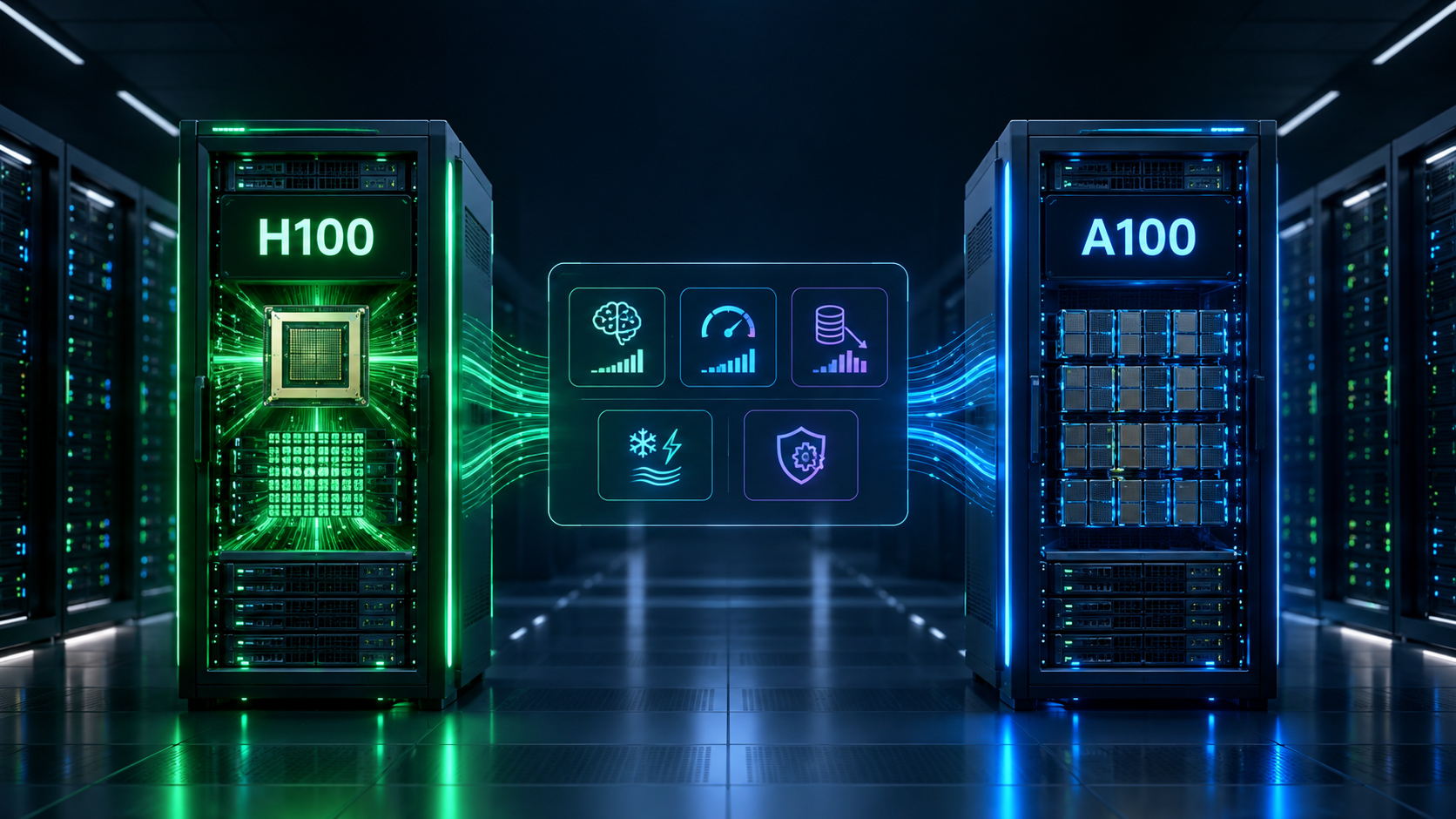
NVIDIA H100 vs. A100: Why Proven GPUs Still Power Modern Infrastructure
Introduction: The Case for Proven Acceleration
Peak performance is only one variable in a GPU infrastructure decision. The accelerator that looks strongest on a specification sheet may not be the one that delivers the best business outcome once software, power, cooling, utilization, procurement, and migration costs are included.That is why NVIDIA H100 and A100 GPUs remain widely deployed. The H100 brings Hopper architecture innovations for demanding artificial intelligence (AI) training and inference, while the A100 continues to provide a mature, flexible platform for inference, fine-tuning, analytics, and mixed workloads. This guide explains where each fits and how to evaluate them as part of a complete fleet strategy.
Key takeaway: The right GPU is not always the newest GPU. It is the one that fits the workload, the operating environment, and the economics of the fleet you need to run.
1. H100: Built for the Most Demanding AI Jobs
- The NVIDIA H100 is based on the Hopper architecture, designed around the computational patterns that define modern AI. Its value is especially clear in transformer-based models, where training and inference depend heavily on fast matrix operations, large memory bandwidth, and efficient communication across multiple GPUs.The H100’s Transformer Engine combines hardware and software techniques to manage precision dynamically for transformer workloads. A central capability is FP8, or 8-bit floating point, acceleration. By using FP8 where the model can tolerate it and higher precision where it is needed, teams can pursue higher throughput without treating every operation as an all-or-nothing accuracy tradeoff.H100 systems also use HBM3, or high-bandwidth memory, to feed the GPU with data at the rates demanding models require. NVLink, NVIDIA’s high-speed GPU interconnect, supports fast communication among GPUs and helps multi-GPU platforms operate as coordinated systems rather than isolated cards.
- Training fit — A strong option for large models, long training runs, and workloads where time-to-solution has a direct operational or commercial impact.
- Inference fit — Well suited to high-throughput or latency-sensitive inference, particularly when transformer optimization and scale-out communication matter.
- Infrastructure fit — Most compelling when the data center can support its power, cooling, topology, and software requirements at sustained utilization.
2. A100: A Flexible Foundation for Mixed Workloads
The NVIDIA A100 is built on the Ampere architecture and remains a practical general-purpose accelerator for many enterprise environments. Its Tensor Cores accelerate the matrix math used in AI, while its broad software support makes it useful beyond a single model family or deployment pattern.The A100 supports TF32, or TensorFloat-32, which helps accelerate compatible training and compute workloads while preserving the numerical range associated with traditional 32-bit floating point. It also supports BF16, or bfloat16, a lower-precision format commonly used in AI workflows. Together, these options give platform teams flexibility when balancing performance, accuracy, and software compatibility.MIG, or Multi-Instance GPU, allows one physical A100 to be partitioned into isolated GPU instances. That can help teams serve multiple smaller jobs, tenants, or services without assigning an entire accelerator to each one. A100 memory options include 40GB and 80GB configurations, using HBM2 or HBM2e depending on the model.These characteristics make A100 a sensible choice for inference services, fine-tuning, data analytics, development environments, and mixed workloads that do not consistently justify the newest accelerator. It can also be a strong fit when an organization already operates A100 systems and wants to extend a stable platform rather than introduce another architecture immediately.
3. Why Both GPUs Remain Relevant Today
- The continued use of H100 and A100 GPUs is not simply a matter of habit. It reflects the economics and operational realities of running production infrastructure.
- Installed base and sunk investment — Existing servers, networking, racks, operating procedures, and support agreements represent real investment. Replacing a working fleet has a cost beyond the accelerator itself.
- Mature CUDA support — CUDA, NVIDIA’s GPU-accelerated computing platform, is deeply integrated into frameworks, libraries, orchestration tools, monitoring systems, and enterprise applications. A mature software path reduces migration friction and validation work.
- Workload fit — Not every application needs the same precision, memory profile, multi-GPU communication, or throughput. A100 can be the better fit for steady inference, fine-tuning, analytics, and shared mixed workloads, while H100 is better aligned with demanding training and high-throughput AI services.
- Availability and procurement — Supply varies by region, form factor, condition, lead time, and lifecycle status. A platform that can be sourced and deployed when needed may be more valuable than a nominally superior option that does not fit the project timeline.
- Performance per dollar and total cost of ownership — Purchase price is only one input. Power, cooling, software, support, utilization, rack density, and migration effort all influence the cost of delivering useful computation.
- Operational consistency — Standardizing on a smaller number of validated configurations simplifies spares, training, monitoring, capacity planning, and incident response across the fleet.
Practical perspective: Relevance is an economic and operational conclusion, not a claim that either GPU is the newest or fastest option in every scenario.
4. H100 vs. A100: Match the GPU to the Job
The choice becomes clearer when evaluated against the workload and the environment in which it will run. The following framework avoids treating a single specification as the decision.
| Decision lens | H100 is the better choice when | A100 remains sensible when |
| AI workload | Transformer-heavy training, demanding inference, or multi-GPU jobs make use of Hopper capabilities, FP8 acceleration, and HBM3. | Inference, fine-tuning, analytics, development, and mixed workloads fit comfortably within an established Ampere environment. |
| Utilization | High sustained utilization can justify a platform optimized for throughput and time-to-solution. | Flexible sharing, including MIG partitioning, helps serve varied or smaller jobs efficiently. |
| Economics | Shorter execution time, higher useful throughput, or fewer required nodes materially improves the business case. | Existing capacity, lower migration effort, and acceptable performance are more important than maximum capability. |
| Procurement | A suitable H100 configuration can be acquired with the required power, cooling, and deployment schedule. | Available A100 inventory or a compatible supply path reduces acquisition and integration risk. |
The decision does not need to be uniform across every team. A shared platform may use H100 for frontier model development and high-value inference while assigning A100 capacity to predictable services, batch analytics, and development workloads. The important question is whether the fleet is being allocated deliberately rather than upgraded by default.
5. Plan the Rack, Not Just the Accelerator
- GPU selection is only the first layer of infrastructure planning. At rack scale, the server design, host-to-GPU balance, network topology, storage path, power delivery, cooling strategy, firmware, monitoring, and support model all influence the result. A GPU that performs well in isolation can still be a poor fit if the surrounding system limits utilization or creates operational complexity.Before standardizing a new deployment or refreshing an existing one, evaluate the full operating context:
- Fleet fit — Identify which workloads need H100 capabilities and which can remain on A100 without creating a service-level or capacity problem.
- Software path — Confirm framework, CUDA, driver, container, orchestration, and observability compatibility before hardware is ordered.
- Power and cooling — Validate rack-level power availability, thermal headroom, airflow or liquid-cooling requirements, and facility constraints.
- Utilization — Measure how much of each accelerator is used, when demand peaks, and whether partitioning or scheduling can improve sharing.
- Support and procurement — Review lead times, form factors, spares, warranties, lifecycle considerations, and the support model for the complete server configuration.
- Migration cost — Include porting, revalidation, retraining, data movement, operational change, and the opportunity cost of disrupting a working service.
- Rack-scale validation — Prefer configurations that have been validated as an integrated system, reducing the risk of discovering compatibility, topology, or thermal issues after deployment.
Newer accelerators may offer higher peak performance, but infrastructure decisions should consider the whole fleet, software stack, power and cooling, utilization, support, and migration cost. That is the difference between buying faster components and building a more effective platform.
Conclusion: Choose for the Fleet You Need to Operate
The H100 is the stronger choice when demanding AI training, high-throughput inference, transformer optimization, HBM3 capacity, and multi-GPU communication justify a newer platform. The A100 remains a sensible choice when workload requirements are moderate, MIG partitioning is valuable, mixed workloads dominate, or an existing Ampere fleet already provides a reliable software and operational foundation.Both GPUs can deliver durable value when they are matched to the right jobs and deployed in a validated, supportable infrastructure design. The best refresh strategy may be a targeted expansion rather than a wholesale replacement: add newer capacity where it changes the economics, and continue using proven capacity where it meets requirements.
Ready to plan your next deployment? Discuss your GPU server and rack infrastructure requirements with PreRack IT and evaluate the right mix of accelerators, systems, and operating constraints for your environment.