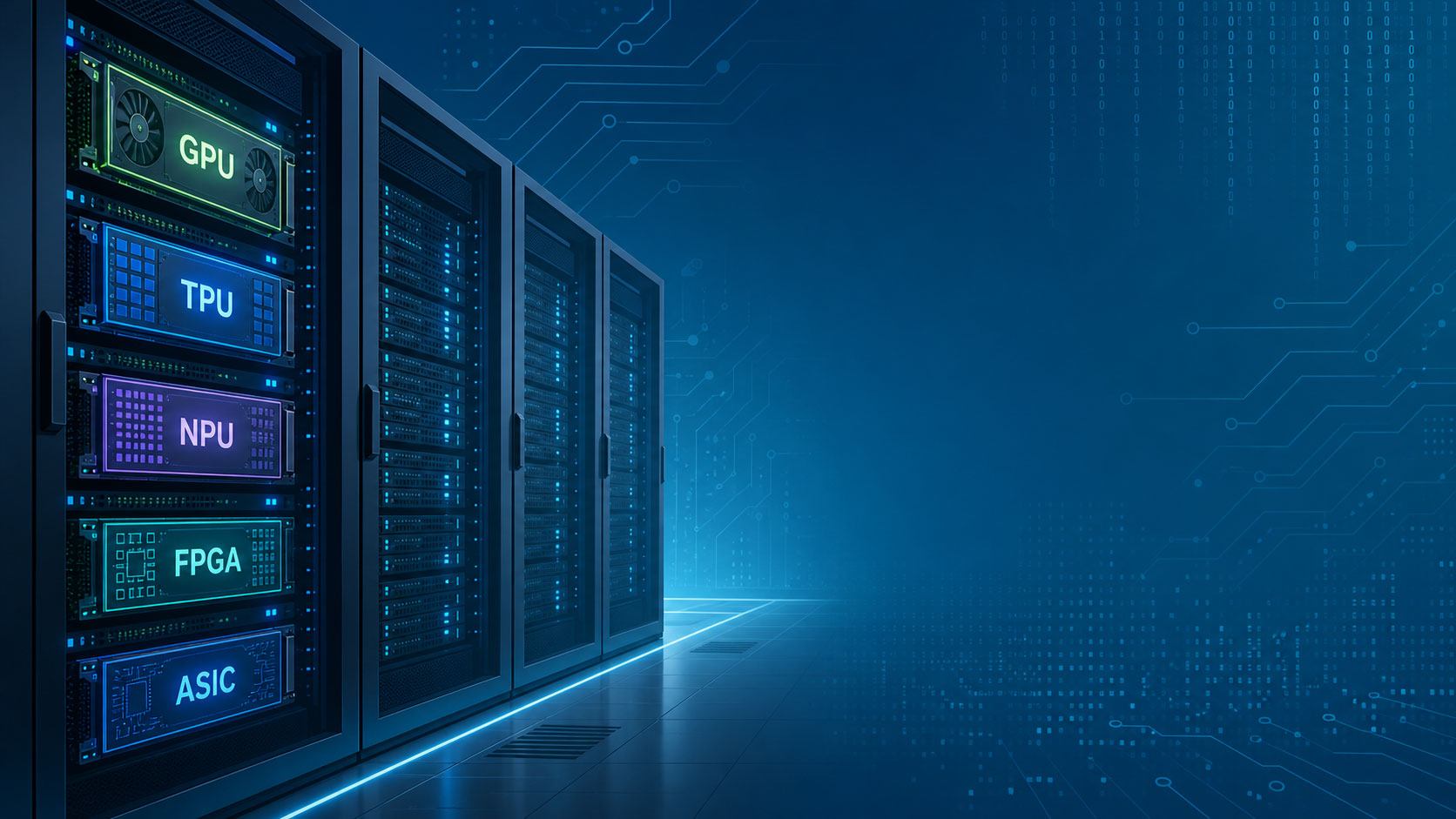
What is an AI Accelerator (GPU, TPU, NPU, FPGA, ASIC) and Why it Matters for Modern Workloads
An AI accelerator is a specialized chip that speeds up AI computations—especially the matrix and tensor math used in neural networks—more efficiently than a general‑purpose CPU. For modern workloads like large language models, real‑time vision, and personalization at scale, these accelerators (GPUs, TPUs, NPUs, FPGAs, ASICs) have become the engine that makes “practical AI” possible instead of purely experimental.
1. What is an AI accelerator?
At a high level, an AI accelerator is a hardware component designed specifically to run AI workloads—training and inference—faster and with better energy efficiency than a CPU alone. Typical AI tasks involve huge numbers of matrix multiplications and tensor operations, which map well to massively parallel architectures rather than the relatively small core counts and control‑heavy design of CPUs.
These accelerators can be discrete cards (like GPUs and many NPUs/ASICs), modules baked into servers, or even blocks integrated inside a CPU package. They offload the “heavy lifting” math from the CPU, which then focuses on orchestration, data movement, and general application logic. In practice, that means training jobs that would take days on CPUs can drop to hours, and real‑time inference becomes feasible for latency‑sensitive applications like fraud detection or voice assistants.
From a data center and infrastructure perspective, accelerators are now a core design input: power density, cooling strategy, networking, and storage layouts are all influenced by how many accelerators you run, how they’re interconnected, and what workloads they target.
2. Why accelerators matter for modern workloads
Modern AI workloads stress systems very differently than traditional web or transactional apps. Training a large model involves billions or trillions of floating‑point operations over huge datasets, and inference at scale might require millions of predictions per second. CPUs can do this, but they’re fundamentally not optimized for that scale of parallel math.
AI accelerators matter for several reasons:
- Performance and latency: Specialized accelerators execute many operations in parallel, dramatically reducing training and inference time, which is critical for use cases like online recommendations, real‑time analytics, and conversational AI.
- Energy efficiency: They deliver much higher performance per watt for AI math than CPUs, which translates directly into lower power bills and denser compute per rack.
- Scalability: Their architecture and interconnects are built for horizontal scaling in clusters, enabling you to distribute large models and datasets efficiently.
- Cost and TCO: Even though accelerators are expensive components, the gain in throughput and efficiency can reduce total infrastructure and operational costs for serious AI deployments.
As AI becomes embedded everywhere—from RAG systems and copilots to industrial automation and smart cameras—accelerators shift from “nice to have” to infrastructure requirement, much like GPUs did for 3D graphics or SSL offload cards did for secure web traffic a decade ago.
3. The main accelerator types: GPU, TPU, NPU, FPGA, ASIC
Different accelerator types exist because “AI workload” is not one thing; training giant models in the cloud, running on‑device inference in a phone, and accelerating an industrial vision system have very different constraints.
3.1 GPUs (Graphics Processing Units)
GPUs are the most widely used and mature class of AI accelerators today, especially in servers and cloud platforms. Originally built for graphics, GPUs contain thousands of relatively simple cores optimized for parallel operations, which turns out to be a perfect match for deep learning math.
Key characteristics of GPUs for AI:
- Extremely strong at dense linear algebra and large‑batch training workloads.
- Rich software ecosystem and frameworks (CUDA, ROCm, optimized libraries) make them the default for researchers and practitioners.
- Very flexible: you can run many model types (vision, NLP, recommendation, etc.) without hardware changes.
For modern workloads, GPUs are often the “workhorse” for both training and high‑throughput inference, particularly in data centers and hyperscale environments.
3.2 TPUs (Tensor Processing Units)
TPUs are Google’s family of application‑specific accelerators designed from the ground up for tensor operations, especially for TensorFlow workloads. They’re implemented as ASICs (more on that below) and optimized for large matrix multiplications and accumulations—the core operations of many deep learning models.
TPUs stand out because:
- They excel at large‑scale training and inference in Google’s cloud, tightly integrated with Google’s data center architecture.
- They’re engineered for high throughput and efficiency on specific workloads, particularly large matrix‑heavy models.
In practical terms, TPUs matter because they represent a trend: hyperscalers building custom AI silicon tuned for their own stacks, which pushes the entire ecosystem toward more specialized hardware.
3.3 NPUs (Neural Processing Units)
NPUs are specialized processors focused on accelerating neural network computations, often with an emphasis on power‑efficient inference on devices like laptops, smartphones, and edge systems. Where GPUs typically target high‑end servers and heavy compute, NPUs target “everyday AI” close to where data is generated.
Common characteristics of NPUs:
- Optimized for low‑latency, low‑power inference, ideal for on‑device AI such as camera enhancements, real‑time translation, and local copilots.
- Often integrated into consumer CPUs, PC SoCs, or mobile chipsets as a dedicated AI engine.
For modern workloads, NPUs enable privacy‑preserving, always‑on AI: instead of sending data to the cloud, you can run models locally, cut latency, and reduce bandwidth costs.
3.4 FPGAs (Field‑Programmable Gate Arrays)
FPGAs are reconfigurable chips that you can “rewire” after manufacturing to implement custom digital logic, including AI accelerators. They sit between general‑purpose GPUs and fixed‑function ASICs in terms of flexibility and efficiency.
Key properties:
- Highly flexible: you can tailor the hardware pipeline for specific models or algorithms and update it as they evolve.
- Strong fit for scenarios that need deterministic latency, special I/O handling, or proprietary algorithms that shouldn’t be exposed in software.
- Typically require more specialized development (HDL or high‑level synthesis tools), which can slow adoption compared with GPUs.
For modern workloads, FPGAs often show up in networking and edge appliances, telco infrastructure, and specialized inference devices where tight timing and custom pipelines matter.
3.5 ASICs (Application‑Specific Integrated Circuits)
ASICs are custom chips built for a particular function, which can include AI model training or inference. TPUs are one example, but many vendors now design their own AI ASICs to capture performance and efficiency gains.
ASICs are characterized by:
- Maximum efficiency and performance per watt for their target workload, because every transistor can be tuned for that purpose.
- Low flexibility: once manufactured, the silicon is fixed, so it’s best for stable algorithms and large‑scale deployments where the NRE costs are justified.
For modern workloads, ASICs power many of the largest AI clusters and cloud services, especially when a provider wants to optimize for a specific model family or workload pattern at hyperscale.
4. How accelerators transform AI performance and efficiency
AI accelerators deliver their impact through architecture. Instead of a few complex cores, they integrate many simpler compute units, specialized memory hierarchies, and high‑bandwidth interconnects all tuned for AI math.
Several design aspects matter:
- Massive parallelism: Accelerators execute thousands or millions of operations in parallel, ideal for the repeated linear algebra operations at the heart of neural networks.
- Optimized memory and data movement: They often include high‑bandwidth memory and custom on‑chip buffers to keep data close to compute units, reducing memory bottlenecks.
- Specialized instruction sets: Instructions and units tailored for tensor operations, quantized arithmetic, and sparsity exploitation can significantly accelerate deep learning workloads.
- Power management: Modern accelerators use techniques like dynamic voltage and frequency scaling to adjust power draw based on workload, improving efficiency.
For organizations, the net effect is that accelerators enable more ambitious models, faster iteration cycles, and the ability to serve AI experiences at scale while keeping energy use and latency under control.
5. Matching accelerators to modern AI workloads
Different AI workloads benefit from different accelerator characteristics, so understanding the landscape helps you design the right hardware stack.
5.1 Training vs inference
- Training workloads are compute‑intensive, long‑running, and often scale across multiple devices and nodes, making GPUs and large ASIC/TPU clusters particularly attractive.
- Inference workloads range from batch processing to hard real‑time response, which can favor GPUs, NPUs, FPGAs, or ASICs depending on latency, power, and deployment footprint.
For example, training a foundation model might use a GPU or TPU supercluster, while running that model in a car or smartphone could rely on a compact NPU designed for millisecond‑scale inference under strict power budgets.
5.2 Cloud, data center, and edge
- Cloud and data centers: GPU servers and AI ASICs dominate, with high‑speed fabrics and shared storage feeding large clusters.
- On‑prem enterprise data centers: Often deploy GPU nodes or hybrid servers with integrated accelerators, balancing AI performance and traditional workloads.
- Edge: NPUs and FPGAs are common where bandwidth is limited, latency must be extremely low, or physical and power constraints are tight.
This distribution lets organizations place compute close to data sources when needed while still leveraging centralized clusters for heavy training and global model updates.
6. Strategic implications for organizations
For businesses, AI accelerators are not just a technical detail—they’re a strategic lever that influences product capabilities, user experience, and competitiveness.
- Faster innovation cycles: Accelerated training lets teams experiment with more architectures and fine‑tune models frequently, improving model quality and time‑to‑market.
- New product experiences: Real‑time personalization, interactive copilots, and responsive vision systems depend on low‑latency inference, which is often only practical with accelerators.
- Infrastructure planning: Data center design now has to consider accelerator density, power and cooling envelopes, and lifecycle planning for specialized hardware.
- Cost, risk, and lock‑in: Choosing between broadly supported GPUs and more specialized ASICs or NPUs involves tradeoffs around ecosystem support, vendor dependence, and long‑term flexibility.
In other words, understanding AI accelerators is part of making smart decisions about where and how you invest in AI—from picking instance types in the cloud to designing on‑prem infrastructure or edge devices.
7. Summary: why accelerators are central to modern AI
Modern AI workloads are defined by scale: more parameters, larger datasets, and tighter latency budgets than traditional computing ever had to handle. AI accelerators—GPUs, TPUs, NPUs, FPGAs, and ASICs—exist because CPUs alone cannot meet those demands efficiently, especially when you factor in power, cost, and user experience.
By offloading the core math of neural networks onto specialized hardware, accelerators make it feasible to train cutting‑edge models, deploy them at global scale, and push AI into everyday devices and workflows. For any organization treating AI as a serious capability rather than a buzzword, understanding and leveraging AI accelerators is now a foundational part of infrastructure strategy.